
Network Security
Wireless Network Security Testing: Wi-Fi Risk, Segmentation, and Rogue Access
How wireless testing evaluates office and campus Wi-Fi authentication, guest isolation, rogue access points, and monitoring.
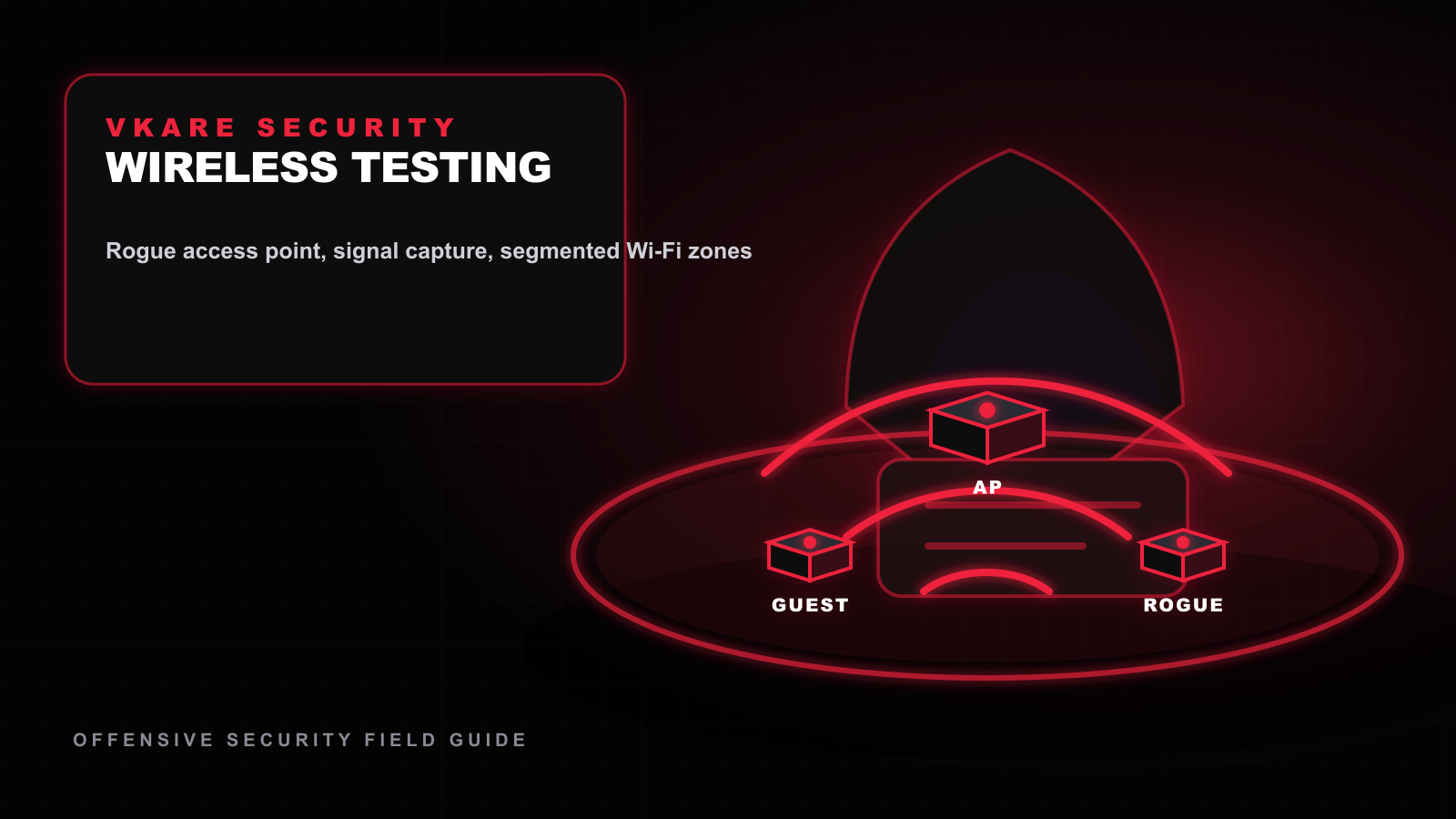
Wireless security testing validates whether physical proximity can become network access, credential exposure, or a path into sensitive systems.
Table of Contents
- Wireless risk in business environments
- Assessment scope
- Common weaknesses
- Risk rating
- Hardening priorities
Wireless Risk in Business Environments
Wireless networks often bridge physical presence and enterprise access. A weak guest network, shared password, rogue access point, or misconfigured enterprise authentication can expose internal services or sensitive traffic.
Testing validates whether wireless access is segmented, authenticated, monitored, and resistant to realistic misuse.
Assessment Scope
Scope should define locations, SSIDs, frequencies, testing windows, authorized equipment, excluded networks, and operational safeguards. Testing should avoid disrupting business connectivity unless a disruptive test is explicitly approved.
Coverage includes encryption mode, authentication design, guest isolation, captive portals, rogue access points, signal leakage, device onboarding, and monitoring.
Common Weaknesses
- Shared or weak pre-shared keys.
- Guest networks that can reach internal services.
- Weak enterprise certificate validation.
- Rogue or evil-twin access point exposure.
- Unmanaged IoT devices on trusted networks.
- No alerting for suspicious wireless events.
Risk Rating
| Severity | Description |
|---|---|
| Critical | Wireless access enables unauthenticated internal network compromise or privileged system access. |
| High | Weak authentication or segmentation exposes sensitive services or credentials. |
| Medium | A limited wireless weakness affects guest, IoT, or constrained networks. |
| Low | A configuration or monitoring gap has limited direct exposure. |
Hardening Priorities
- Use strong enterprise authentication where practical.
- Segment guest, corporate, and IoT networks.
- Validate certificate settings and onboarding flows.
- Rotate shared secrets and remove stale devices.
- Monitor for rogue access points and unusual associations.
Wireless Security Checklist
- Approved SSIDs, locations, and test windows are documented.
- Guest and IoT networks are isolated from internal systems.
- Enterprise authentication is configured securely.
- Rogue access point monitoring is enabled.
- Wireless findings are retested after configuration changes.