
Vulnerability Management
Vulnerability Assessment vs Penetration Testing: When You Need Each
A practical comparison of broad vulnerability visibility, exploit validation, prioritization, and remediation evidence.
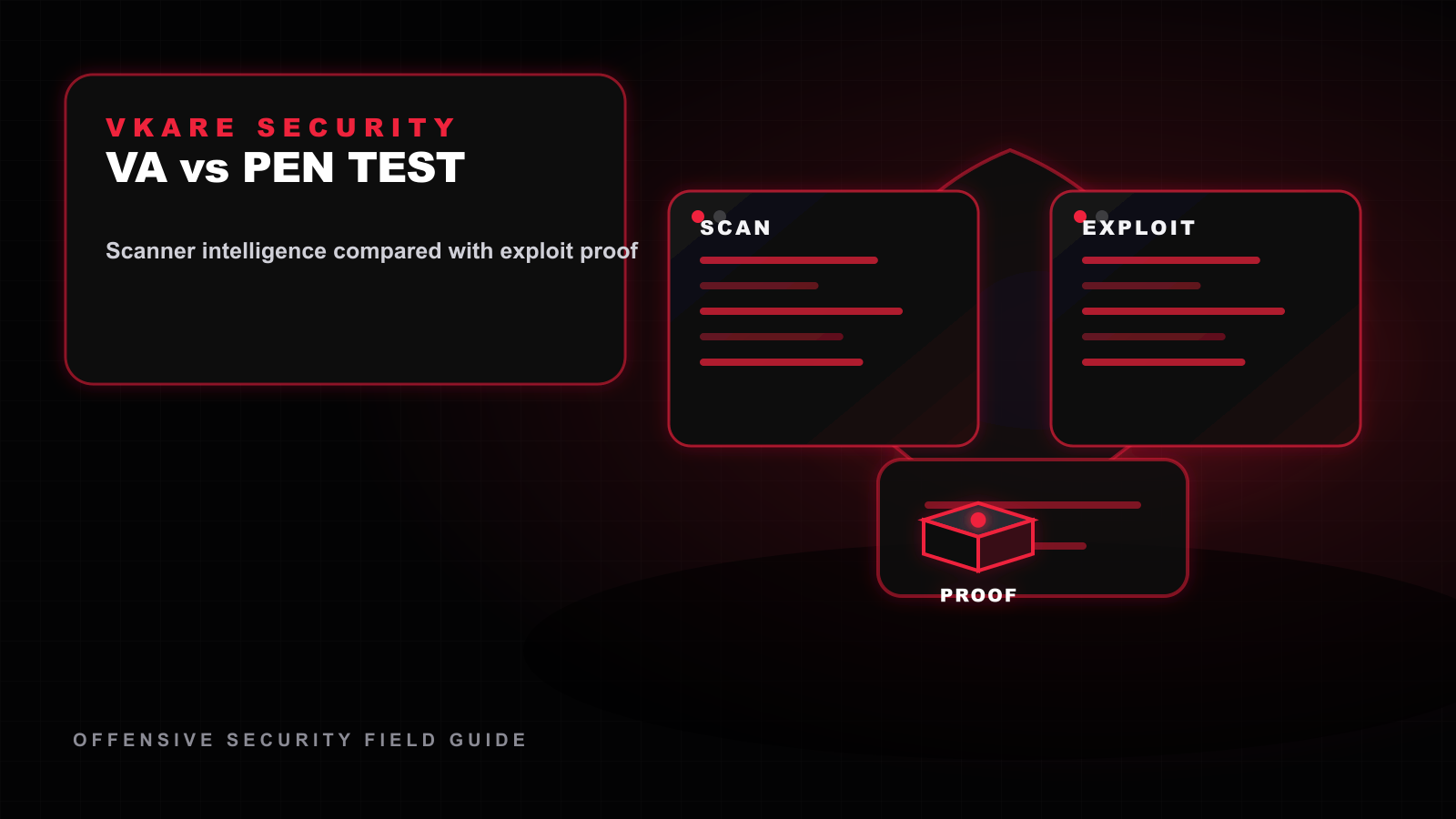
Vulnerability assessment and penetration testing solve different problems. Used together, they help teams reduce known exposure and validate realistic attack paths.
Table of Contents
- What a vulnerability assessment is
- How it differs from penetration testing
- When to use each
- Risk rating
- Operationalizing results
What a Vulnerability Assessment Is
A vulnerability assessment identifies known weaknesses across systems, applications, dependencies, and configurations. It is usually broader than a penetration test and is useful for inventory, hygiene, and prioritization.
The output should not be a raw scanner export. It should connect findings to assets, owners, exposure, exploitability, and remediation evidence.
How It Differs From Penetration Testing
A penetration test validates whether selected weaknesses can be exploited in a realistic path. A vulnerability assessment focuses on breadth and recurring visibility.
Most organizations need both: continuous assessment to reduce known exposure and periodic penetration testing to validate how controls behave under adversarial pressure.
When to Use Each
- Use vulnerability assessment for recurring patch and configuration visibility.
- Use penetration testing before major launches, after architecture changes, or for high-risk systems.
- Use both when internet-facing or regulated systems carry sensitive data.
- Use retesting to prove that high-risk fixes worked.
Risk Rating
| Severity | Description |
|---|---|
| Critical | Confirmed exploitable weakness affects exposed, privileged, or business-critical systems. |
| High | Known serious vulnerability is present on sensitive or reachable assets. |
| Medium | Weakness has constrained exposure or compensating controls. |
| Low | Hardening gap or informational issue with limited business impact. |
Operationalizing Results
Assign each finding to an owner and deadline, validate fixes, document accepted risk, and track recurring causes. The best programs measure exposure reduction, not only ticket closure.
Vulnerability Management Checklist
- Assets have owners, criticality, and exposure context.
- Findings are deduplicated and prioritized.
- Known exploited vulnerabilities receive urgent review.
- Exceptions are owned and time-bound.
- Remediation is verified with evidence.