
Attack Surface Management
External Attack Surface Assessment: Find What Attackers See First
How to discover, validate, prioritize, and reduce public exposure across domains, cloud services, and forgotten assets.
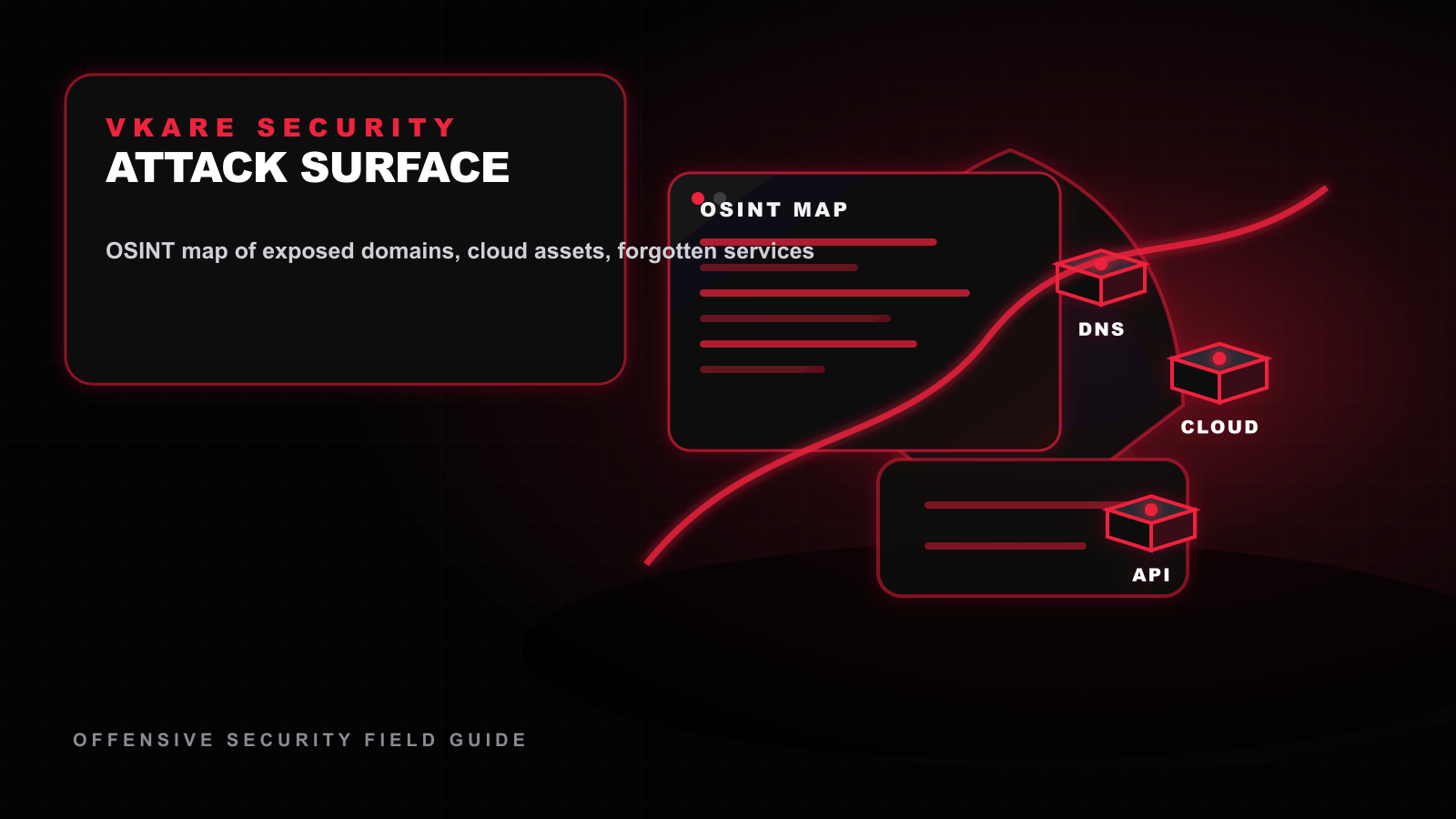
External attack surface assessment identifies the public systems, services, and metadata that attackers can discover before they ever interact with your team.
Table of Contents
- What attack surface means
- Discovery and validation
- Shadow assets
- Risk rating
- Reducing exposure
What Attack Surface Means
External attack surface is everything reachable from the internet that could represent your organization: domains, subdomains, cloud services, IPs, certificates, exposed applications, remote access portals, storage, third-party-hosted systems, and forgotten test environments.
The purpose is to find what attackers can see before they interact deeply with your organization.
Discovery and Validation
Discovery combines DNS, certificates, passive internet data, cloud naming patterns, web fingerprints, and safe validation. Every candidate asset should be confirmed and tied to an owner before action is assigned.
The highest value comes from separating real exposure from noise: abandoned assets, unknown portals, publicly reachable admin panels, vulnerable versions, weak TLS, leaked metadata, and exposed storage.
Shadow Assets
Shadow assets are systems that exist outside normal governance. They may be created for a campaign, proof of concept, acquisition, temporary vendor project, or forgotten migration.
They are risky because they may lack patching, monitoring, ownership, backup, and incident response coverage.
Risk Rating
| Severity | Description |
|---|---|
| Critical | An unknown or exposed asset permits immediate compromise of sensitive data or privileged systems. |
| High | An internet-facing service has a known exploitable weakness or weak authentication. |
| Medium | Exposure is real but exploitation requires additional conditions. |
| Low | A minor metadata, TLS, or hygiene issue should be corrected as part of baseline hardening. |
Reducing Exposure
- Assign an owner to every public asset.
- Remove forgotten or duplicate services.
- Protect remote access and administration with MFA and allowlists where appropriate.
- Patch internet-facing systems quickly.
- Monitor certificates, DNS changes, and newly exposed services continuously.
External Attack Surface Checklist
- Domains, subdomains, IPs, certificates, and cloud endpoints are inventoried.
- Every confirmed asset has an owner and business purpose.
- Unknown or abandoned services are removed.
- Internet-facing admin and remote access paths are hardened.
- New exposure is monitored continuously.